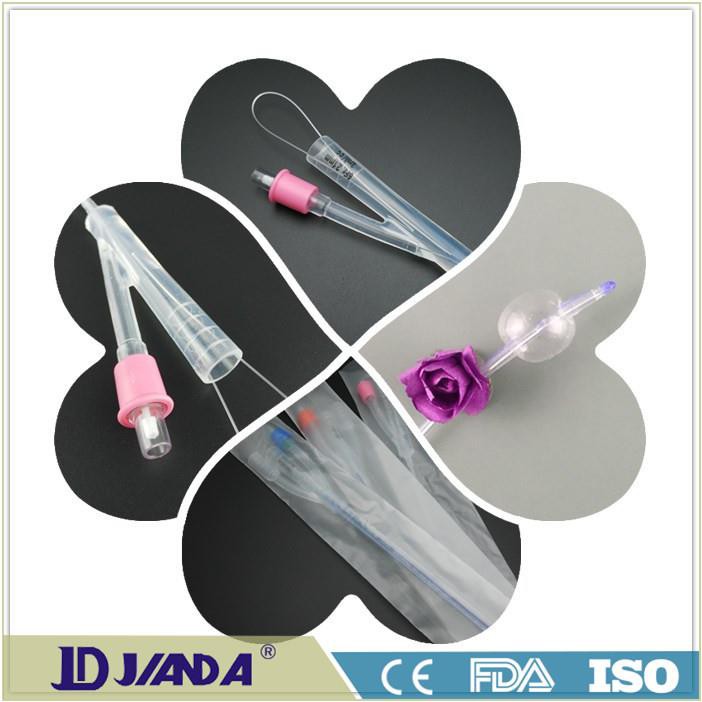


Pediatric Silicone Foley Catheter
The balloon catheter, also known as Pediatric Silicone Foley Catheter, has been widely used clinically as a replacement for common catheters.
The utility model has the advantages of simple operation, soft wall, small irritation to the mucous membrane, stable internal fixation, no need of adhesive tape fixation, and large degree of adhesion to the urinary catheter after insertion.
Description
Description
The balloon catheter, also known as Pediatric Silicone Foley Catheter, has been widely used clinically as a replacement for common catheters. The utility model has the advantages of simple operation, soft wall, small irritation to the mucous membrane, stable internal fixation, no need of adhesive tape fixation, and large degree of adhesion to the urinary catheter after insertion.
Parameter

How to insert Pediatric Silicone Foley Catheter correctly?
1) Supine position, separated from the lower limbs.
2) Open the catheter bag and wear sterile gloves.
3) Disinfect the vulva with side branches and iodine.
4) For boys, open the adhesive foreskin, clean the penis head, lift the penis with your left hand, and use your right hand to hold the catheter and the urethra head 2-3 cm with tweezers or both hands. Insert the catheter coated with liquid paraffin into the urethra, and immediately The catheter is fixed in the urethra of the head of the penis with the left hand to prevent slipping out; and the catheter is gently bent along the urethra to enter the bladder. For girls, use the left hand to separate the vulva and insert the urethral opening in the upper part of the vagina into the vagina.
5) When the catheter leaves the urine, it just enters the bladder and is inserted into the bladder 2 to 3 cm.
Note: Avoid injecting the urethra into the bladder before injecting the bladder or dilating the balloon to prevent damage to the urethra.
Picture

Send Inquiry
You Might Also Like