

A blood pressure monitor is a device used to measure the pressure exerted by circulating blood on the walls of blood vessels. It typically measures two values: systolic pressure, which is the pressure when the heart contracts, and diastolic pressure, which is the pressure when the heart relaxes. Blood pressure monitors can be manual or automatic. Manual monitors require the user to manually inflate and deflate the cuff, while automatic monitors automatically inflate and deflate the cuff. Blood pressure monitors are widely used in healthcare settings and at home to monitor blood pressure levels and detect any abnormalities. Regular monitoring can help detect hypertension or hypotension, which could lead to serious health problems if left untreated.
Why Choose Us
High quality
Our products are manufactured or executed to a very high standard, using the finest materials and manufacturing processes.
Advanced equipment
A machine, tool or instrument designed with advanced technology and functionality to perform highly specific tasks with greater precision, efficiency and reliability.
Quality control
We have built a professional quality control team to accurately inspect every raw material and every production process.
Professional team
Our professional team collaborates and communicates effectively with each other, and is dedicated to delivering high quality results. We are capable of handling complex challenges and projects that require our specialized expertise and experience.
Customized services
We understand that each customer has unique manufacturing needs. That’s why we offer customization options to cater to your specific requirements.
24H online service
We try and respond to all concerns within 24 hours and our teams are always at your disposal in case of any emergencies.


Advantages of Blood Pressure Monitor
Convenient and easy to use
Blood pressure monitors are designed to be user-friendly, allowing individuals to measure their blood pressure in the comfort of their own homes. They are simple to operate and provide instant results, making it convenient for regular monitoring.
Early detection of hypertension
Hypertension, or high blood pressure, is often referred to as the "silent killer" because it often has no noticeable symptoms. Regular monitoring with a blood pressure monitor can help detect hypertension early, allowing for timely intervention and management.
Personalized monitoring
Each individual's blood pressure can vary throughout the day due to factors like stress, physical activity, and medication. With a personal blood pressure monitor, individuals can track their blood pressure at different times of the day, providing a more accurate picture of their overall blood pressure patterns.
Empowerment and self-management
Monitoring blood pressure at home empowers individuals to take control of their health. It allows them to actively participate in their own healthcare by monitoring their progress, making lifestyle changes, and adhering to medication regimens as prescribed by their healthcare provider.
Timely intervention and prevention
By monitoring blood pressure regularly, individuals can identify any significant changes or fluctuations in their readings. This allows for timely intervention and prevention of complications associated with high blood pressure, such as heart disease, stroke, and kidney problems.
Enhanced communication with healthcare providers
Blood pressure monitors often come with features that allow individuals to store and track their readings over time. This data can be shared with healthcare providers during appointments, facilitating more informed discussions and personalized treatment plans.

Types of Blood Pressure Monitor
Manual blood pressure monitor
This type of monitor requires the use of a stethoscope and a sphygmomanometer to measure blood pressure. The healthcare professional or user inflates the cuff and listens for the first and last sounds to determine the systolic and diastolic pressure, respectively. While manual monitors are more accurate, they require training to use properly.
Automated blood pressure monitor
This type of monitor uses an electronic sensor to measure blood pressure. The user simply needs to wrap the cuff around their arm, and the monitor will automatically inflate and deflate the cuff to take the measurement. Automated monitors are easy to use and provide quick results, but they may not be as accurate as manual monitors.
Aneroid blood pressure monitor
This type of monitor uses an aneroid sensor to measure blood pressure. It is similar to a manual monitor, but it does not require a stethoscope. The user inflates the cuff and listens for the first and last sounds to determine the systolic and diastolic pressure. Aneroid monitors are portable and affordable, but they may not be as accurate as manual or automated monitors.
Infrared blood pressure monitor
This type of monitor uses infrared technology to measure blood pressure. It measures the pulsations of the blood vessels using infrared light, which is reflected back to the sensor. Infrared monitors are non-invasive and comfortable to use, but they are also more expensive than other types of monitors.
Wearable blood pressure monitor
This type of monitor is designed to be worn on the wrist or arm and continuously measure blood pressure. These devices are convenient for people who need to monitor their blood pressure regularly, but they may not be as accurate as other types of monitors.
Application of Blood Pressure Monitor
Blood pressure monitors are essential tools for managing hypertension, which is a condition in which the blood pressure is consistently too high. Regular monitoring of blood pressure levels can help detect hypertension early, allowing for prompt treatment and management of the condition. Blood pressure monitors help healthcare professionals and patients track blood pressure levels over time, identify trends and patterns, and make necessary adjustments to treatment plans.
Blood pressure monitors are also useful for managing other chronic diseases, such as diabetes, heart failure, and chronic kidney disease. These conditions can cause changes in blood pressure levels, and regular monitoring can help identify any abnormalities and prompt necessary treatment.
Blood pressure monitoring is an important part of pre-operative assessment. It helps healthcare professionals identify patients who may be at risk for perioperative complications, such as hypertension or hypotension, and allows them to take appropriate measures to minimize these risks.
Blood pressure monitoring can also be useful for athletes and fitness enthusiasts who want to track their cardiovascular health and optimize their training programs. Regular monitoring of blood pressure levels can help identify any abnormalities and provide valuable feedback on the effectiveness of training programs and dietary habits.
With the rise of telemedicine and remote patient monitoring, blood pressure monitors have become increasingly popular for home monitoring. Patients with hypertension or other chronic diseases can use these devices to track their blood pressure levels at home and share the data with their healthcare providers, allowing for more personalized and effective treatment plans.
How to Store Blood Pressure Monitor

01.Keep it dry and moisture-free
02.Avoid extreme temperatures
03.Keep it clean
04.Unplug and power off
05.Store in original packaging
06.Keep it secure
07.Regular maintenance
A blood pressure monitor is a medical device that measures the pressure of blood in the arteries of the human body. It works by detecting the force exerted by blood on the walls of arteries and converts this pressure into a readable form for medical assessment. The basic components of a blood pressure monitor include a pressure sensor, a display unit, and a cuff or other attachment that encircles the limb where blood pressure is being measured. The pressure sensor measures the force exerted by blood on the walls of arteries and converts it into an electrical signal. This signal is then processed by the monitor's electronic circuitry, which converts it into a numerical reading that is displayed on the display unit. To measure blood pressure, the cuff is wrapped around the upper arm or forearm and inflated to a pressure that compresses the arteries. The monitor measures the pressure exerted by the cuff on the arteries and compares it to the pressure exerted by the blood within the arteries. By gradually reducing the pressure in the cuff, the monitor detects the moment when blood starts to flow through the arteries, which is recorded as the systolic blood pressure. The monitor continues to reduce the pressure until blood flow through the arteries stops, at which point it records the diastolic blood pressure. The readings obtained from a blood pressure monitor can provide valuable information about cardiovascular health and help diagnose conditions such as hypertension or hypotension. However, it is essential to use an accurate and reliable monitor that has been properly calibrated. It is also important to follow the manufacturer's instructions for use and to ensure that readings are taken at regular intervals and under consistent conditions.


Blood pressure monitoring is an essential aspect of maintaining cardiovascular health, and blood pressure monitors play a vital role in this process. However, the accuracy of blood pressure monitors can vary depending on the type of monitor and how it is used. Manual blood pressure monitors, which use a stethoscope and a sphygmomanometer to measure blood pressure, are considered the most accurate type of blood pressure monitor. They are typically used in medical settings by trained professionals who are skilled in taking blood pressure measurements. However, manual monitors can be time-consuming and require training to use properly. Automated blood pressure monitors are widely used in both medical settings and for home monitoring. These monitors use an electronic sensor to measure blood pressure and are easy to use. However, their accuracy can be affected by several factors, such as the user's movement during measurement, the tightness of the cuff, and the user's position during measurement. Aneroid blood pressure monitors are similar to manual monitors but do not require a stethoscope. They are considered more accurate than automated monitors but may require more training to use properly. Infrared blood pressure monitors use infrared technology to measure blood pressure and are considered non-invasive and comfortable to use. However, their accuracy and reliability have not been extensively studied, and more research is needed to determine their effectiveness. Wearable blood pressure monitors are designed to be worn on the wrist or arm and continuously measure blood pressure. While they are convenient for people who need to monitor their blood pressure regularly, their accuracy may not be as reliable as other types of monitors.
Regular monitoring of blood pressure is crucial for individuals with hypertension or those at risk of developing the condition. Blood pressure monitors are widely used in healthcare settings and at home, and they have become increasingly popular for home monitoring. However, it is important to understand how often to measure blood pressure at home for accurate and reliable results. The frequency of blood pressure monitoring depends on several factors, including the individual's age, medical history, medications, and lifestyle habits. In general, it is recommended to measure blood pressure at home at least once a day, in the morning and evening, for accurate monitoring. For individuals with hypertension, it is recommended to measure blood pressure at home at least once a day, in the morning and evening, to monitor their condition and make necessary adjustments to their treatment plan. It is also important to monitor blood pressure before and after meals and exercise to identify any changes that may affect blood pressure levels. For individuals at risk of developing hypertension, it is recommended to measure blood pressure at home at least once a week to monitor their blood pressure levels and identify any potential problems early on. It is important to note that blood pressure levels can vary throughout the day due to factors such as stress, activity level, and time of day. Therefore, it is recommended to take multiple measurements over time to identify any trends or patterns in blood pressure levels. In addition to regular monitoring, it is important to follow proper technique when taking blood pressure measurements at home. This includes ensuring that the cuff is placed properly on the arm, the arm is supported and at heart level, and the individual is sitting still and relaxed during measurement.


Wrist blood pressure monitors have become increasingly popular as an alternative to traditional arm cuff blood pressure monitors. These devices are worn like a watch and can provide a quick and convenient way to measure blood pressure. However, it is important to understand whether wrist blood pressure monitors can be used as a substitute for arm cuff monitors. Wrist blood pressure monitors work by measuring the pressure in the radial artery in the wrist. The device uses a small cuff to compress the wrist and then measures the pressure in the artery as the cuff is deflated. While wrist monitors can provide a quick and convenient way to measure blood pressure, they may not be as accurate as arm cuff monitors. One of the main advantages of wrist blood pressure monitors is their portability and convenience. They are small and easy to carry around, and they can be used anytime, anywhere. This can be especially useful for individuals who need to monitor their blood pressure regularly, such as those with hypertension or those on medication for blood pressure. However, wrist blood pressure monitors may not be as accurate as arm cuff monitors. The accuracy of a blood pressure reading can be affected by several factors, such as the tightness of the cuff, the position of the arm during measurement, and the individual's movement during measurement. Wrist monitors may also be less accurate in individuals with smaller wrist sizes or those with limited mobility in their hands. In addition, wrist monitors may not be suitable for all individuals. For example, individuals with Raynaud's syndrome or other conditions that affect blood flow to the fingers and hands may not be able to use wrist monitors effectively. It is important to note that while wrist blood pressure monitors can provide a quick and convenient way to measure blood pressure, they should not be used as a substitute for arm cuff monitors. Arm cuff monitors are considered the gold standard for blood pressure measurement and are widely used in medical settings. Arm cuff monitors provide more accurate and reliable readings and are recommended for individuals who need to monitor their blood pressure regularly.
How Can I Ensure Accurate Blood Pressure Measurements?
Choose the right monitor
There are various types of blood pressure monitors available, including manual arm cuff monitors, automated arm cuff monitors, and wrist monitors. Arm cuff monitors are the most commonly used and are considered the most accurate. Automated monitors are easier to use and provide quick results, while wrist monitors may not be as accurate.
Follow proper technique
Proper technique is crucial for accurate blood pressure measurement. The individual should be seated with their back supported and feet flat on the ground. The arm should be supported at heart level and relaxed, with the cuff placed properly on the upper arm. The individual should also avoid smoking, eating, or drinking caffeine before taking a measurement.
Take multiple measurements
Blood pressure can vary depending on the time of day, activity level, and stress. Therefore, it is recommended to take multiple measurements over time to identify any trends or patterns in blood pressure levels. It is also important to take measurements at the same time of day and under similar conditions to compare results accurately.
Record measurements accurately
Accurate recording of blood pressure measurements is crucial for tracking changes over time and making necessary adjustments to treatment plans. It is important to record the date and time of each measurement, as well as the systolic and diastolic blood pressure readings. Blood pressure readings should be recorded in the appropriate units (mmHg) and documented in a blood pressure logbook or electronic device.
Consult with a healthcare professional
While home blood pressure monitoring can be useful, it is important to consult with a healthcare professional to ensure accurate interpretation of results and appropriate management of hypertension. A healthcare professional can provide guidance on interpreting blood pressure readings, adjusting medication dosages, and developing a treatment plan based on individual needs and preferences.
Blood pressure monitors are widely used devices that measure the pressure exerted by blood on the walls of the arteries. These monitors are essential for diagnosing and managing hypertension, a condition that affects millions of people worldwide. However, the question arises whether a blood pressure monitor can detect irregular heart rhythms, also known as arrhythmias. The short answer is no. Blood pressure monitors are not designed to detect irregular heart rhythms. These devices measure the pressure exerted by the blood in the arteries, while arrhythmias are related to the electrical activity of the heart. Arrhythmias occur when the electrical signals that coordinate the heart's contractions become abnormal, leading to irregular heartbeats. To detect arrhythmias, healthcare professionals typically use devices such as electrocardiograms (ECGs) or wearable heart rate monitors. These devices measure the electrical activity of the heart and can identify abnormal patterns that indicate an arrhythmia. Some wearable devices, such as smartwatches, even have built-in sensors that can detect atrial fibrillation, a common type of arrhythmia. While blood pressure monitors cannot detect arrhythmias, they are still essential for monitoring and managing high blood pressure, a risk factor for heart disease and stroke. High blood pressure can cause damage to the blood vessels and lead to a range of cardiovascular problems, including heart attack and stroke. Therefore, regular monitoring of blood pressure levels is crucial for individuals at risk of developing these conditions.
Are There Any Special Considerations for Older Adults Using Blood Pressure Monitors?

Older adults are at an increased risk of developing hypertension, a condition that can lead to heart disease, stroke, and other cardiovascular problems. Therefore, it is important for older adults to monitor their blood pressure regularly and take appropriate measures to manage their condition. However, there are some special considerations to keep in mind when using blood pressure monitors in this population. Firstly, it is important to choose an appropriate blood pressure monitor for older adults. Manual arm cuff monitors are the most commonly used and are considered the most accurate. However, they require some level of manual dexterity to operate, which may be challenging for some older adults. In such cases, automated arm cuff monitors may be a better option as they are easier to use and provide quick results. Secondly, proper technique is crucial for accurate blood pressure measurement in older adults. This population may have more variability in their blood pressure due to age-related changes in the cardiovascular system. Therefore, it is important to follow proper technique, such as supporting the arm at heart level and ensuring that the cuff is placed properly on the upper arm. Additionally, older adults should avoid smoking, eating, or drinking caffeine before taking a measurement to ensure accurate results. Thirdly, it is important to take multiple measurements over time to identify any trends or patterns in blood pressure levels in older adults. Blood pressure can vary depending on the time of day, activity level, and stress. Therefore, taking measurements at the same time of day and under similar conditions can help compare results accurately. Fourthly, it is important to record blood pressure measurements accurately in older adults. Accurate recording of blood pressure readings can help individuals and healthcare professionals track changes over time and make necessary adjustments to treatment plans. It is important to record the date and time of each measurement, as well as the systolic and diastolic blood pressure readings. Blood pressure readings should be recorded in the appropriate units (mmHg) and documented in a blood pressure logbook or electronic device. Finally, it is important to consult with a healthcare professional when using blood pressure monitors in older adults. While home blood pressure monitoring can be useful, it is important to consult with a healthcare professional to ensure accurate interpretation of results and appropriate management of hypertension. A healthcare professional can provide guidance on interpreting blood pressure readings, adjusting medication dosages, and developing a treatment plan based on individual needs and preferences.
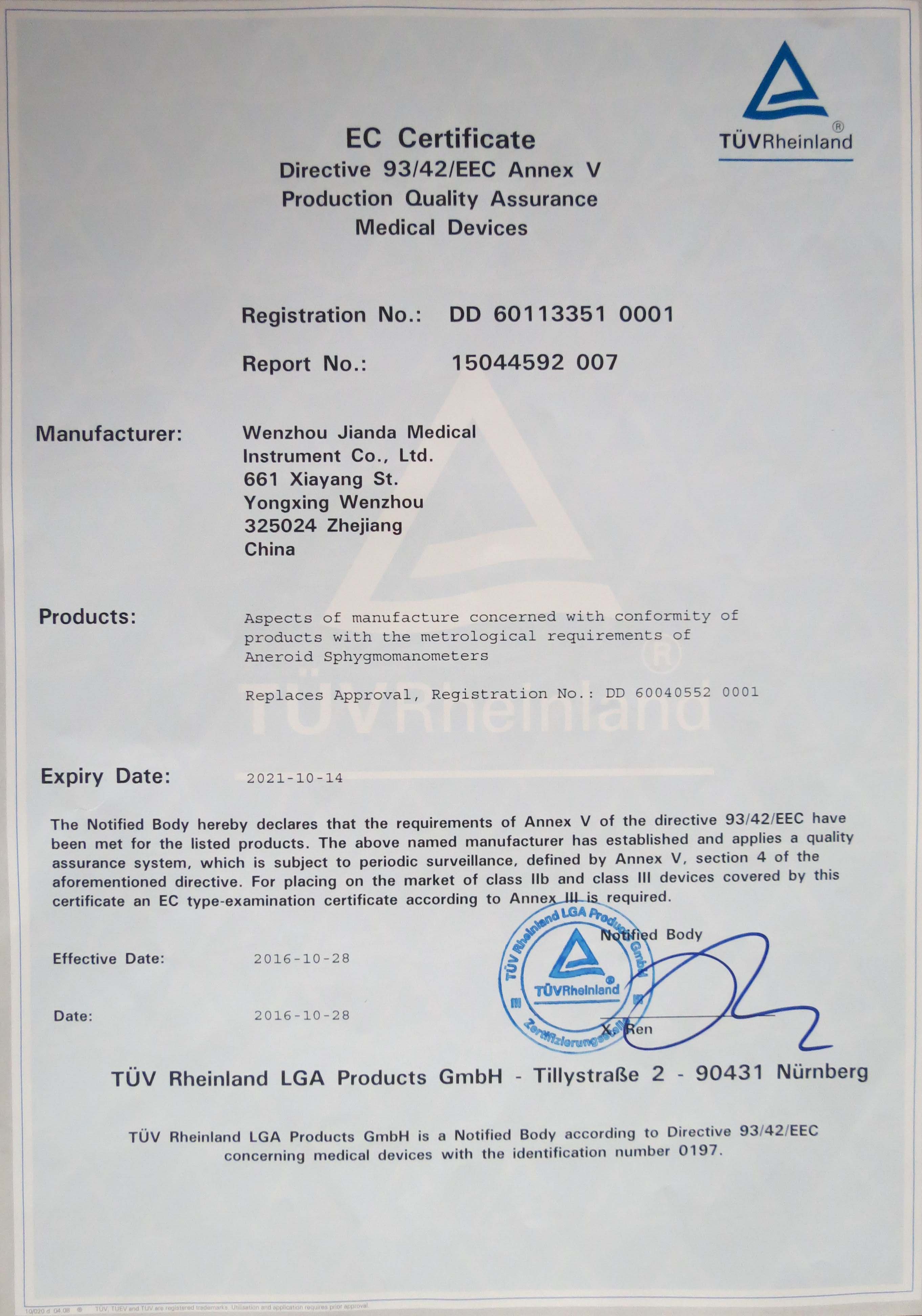
Our factory
Wenzhou Jianda Medical Instrument Co.,Ltd. is a manufacturer and supplier of aneroid sphygmomanometer, stethoscope and other medical instruments such as digital blood pressure monitor,digital thermometer, medical device accessories. We produce more than 500,000 sets of sphygmomanometers and stethoscopes every year and our products have been exported to USA, EEC and many other countries.
Our Certificate

FAQ
Q: Why is it important to monitor blood pressure?
Q: How does a blood pressure monitor work?
Q: What are the different types of blood pressure monitors?
Q: How accurate are blood pressure monitors?
Q: How often should I measure my blood pressure at home?
Q: What is the ideal blood pressure reading?
Q: What is systolic blood pressure?
Q: What is diastolic blood pressure?
Q: What is considered high blood pressure?
Q: Can stress affect blood pressure readings?
Q: Can I use a wrist blood pressure monitor instead of an arm cuff?
Q: Are there any risks associated with using a blood pressure monitor?
Q: How can I ensure accurate blood pressure measurements?
Q: Can lifestyle changes help lower blood pressure?
Q: Can a blood pressure monitor detect irregular heart rhythms?
Q: Can I use a blood pressure monitor during pregnancy?
Q: How long does a blood pressure measurement take?
Q: Can I use a blood pressure monitor on children?
Q: Are there any special considerations for older adults using blood pressure monitors?
Q: How often should I replace my blood pressure monitor?