

A thermometer is a device used to measure temperature. It consists of a bulb, which contains a liquid or gas, and a long tube called a stem. When the temperature of the object being measured changes, the liquid or gas in the bulb expands or contracts, causing the level in the stem to rise or fall. The temperature is then read from a scale marked on the stem. Thermometers can be used to measure the temperature of the human body, food, liquids, gases, and even the Earth's atmosphere. They are essential tools in science, medicine, cooking, and many other fields.
Why Choose Us
High quality
Our products are manufactured or executed to a very high standard, using the finest materials and manufacturing processes.
Advanced equipment
A machine, tool or instrument designed with advanced technology and functionality to perform highly specific tasks with greater precision, efficiency and reliability.
Quality control
We have built a professional quality control team to accurately inspect every raw material and every production process.
Professional team
Our professional team collaborates and communicates effectively with each other, and is dedicated to delivering high quality results. We are capable of handling complex challenges and projects that require our specialized expertise and experience.
Customized services
We understand that each customer has unique manufacturing needs. That’s why we offer customization options to cater to your specific requirements.
24H online service
We try and respond to all concerns within 24 hours and our teams are always at your disposal in case of any emergencies.


Advantages of Thermometer
Accurate measurements of temperature
Firstly, a thermometer provides accurate measurements of temperature. This is essential in many applications where precise temperature measurements are required. For example, in medicine, an accurate temperature reading is necessary to diagnose and monitor a range of conditions, including fever, hypothermia, and hyperthermia. In cooking, precise temperature measurements ensure that food is cooked to the correct internal temperature to ensure food safety.
Versatile
Thirdly, thermometers are versatile and can be used in various applications. There are different types of thermometers designed for different purposes. For example, clinical thermometers are designed to measure body temperature, while meat thermometers are designed to measure the internal temperature of food. Some thermometers can even measure the temperature of gases or extremely high temperatures.
Easy to use and read
Secondly, thermometers are easy to use and read. Most thermometers have clear markings and scales that make it easy to read the temperature. Some digital thermometers even display the temperature reading on an lcd screen, making it even easier to read. This simplicity makes thermometers accessible to everyone, from professionals to consumers.
Safe
Fourthly, thermometers are safe to use. Most thermometers are non-invasive, meaning they do not require puncturing the skin or coming into contact with bodily fluids. This makes them safe to use for people of all ages, including infants and the elderly.

One of the most common types of thermometers is the mercury-in-glass thermometer, which consists of a glass tube containing mercury. As the temperature changes, the mercury expands or contracts, causing the level in the tube to rise or fall. These thermometers are accurate and reliable but can be fragile and pose a risk of mercury exposure if broken. Another type of thermometer is the digital thermometer, which uses a sensor to measure temperature and displays the reading on an LCD screen. Digital thermometers are accurate, easy to use, and can be used for a wide range of applications, including body temperature, food, and liquids. Infrared thermometers are another type of non-contact thermometer that uses infrared technology to measure the temperature of an object from a distance. They are useful in applications where contact with the object is not possible or desirable, such as in industrial processes or food preparation. Thermocouples are a type of temperature sensor that consists of two different metals joined together at each end. As the temperature changes, a voltage is generated, which can be measured and used to determine the temperature. Thermocouples are widely used in industrial processes and scientific research because they are accurate, reliable, and can measure extremely high temperatures. Fluid-filled thermometers are another type of thermometer that uses a liquid or gas to measure temperature. As the temperature changes, the fluid expands or contracts, causing the level in the thermometer to rise or fall. These thermometers are often used in weather stations to measure temperature, and some models can even measure humidity and barometric pressure.
Thermometers are devices used to measure temperature, which is an important physical parameter in various fields such as medicine, cooking, meteorology, and scientific research. The applications of thermometers are vast and varied, and they play a crucial role in ensuring safety, accuracy, and quality in many different fields. In medicine, thermometers are used to measure body temperature, which is an important indicator of health. Doctors and nurses use thermometers to diagnose and monitor a range of conditions, including fever, hypothermia, and hyperthermia. Digital thermometers are commonly used in medical settings because they are accurate, easy to use, and can provide a quick and reliable temperature reading. In cooking, thermometers are used to measure the internal temperature of food to ensure that it is cooked to the correct temperature for food safety. Meat thermometers are commonly used to measure the temperature of meat, while candy thermometers are used to measure the temperature of sugar syrups. Digital thermometers are also used in cooking to measure the temperature of ovens and grills. In meteorology, thermometers are used to measure air temperature, which is an important factor in weather forecasting. Weather stations use thermometers to measure the temperature of the air, as well as other factors such as humidity and wind speed. This information is used to create weather forecasts and to predict temperature changes over time. In scientific research, thermometers are used to measure the temperature of various substances and environments. For example, in chemistry labs, thermometers are used to measure the temperature of reactions, while in biology labs, they are used to measure the temperature of incubators and other equipment. Thermometers are also used in industrial processes to measure the temperature of gases, liquids, and solids.

How to Store Thermometer

01.Choose a dry and clean place
02.Keep it away from extreme temperatures
03.Protect it from impact
04.Keep it separate from other devices
05.Regular maintenance
06.Store it in an upright position
07.Label it
A thermometer is a device that measures temperature. It works by converting the physical state of a substance, usually mercury or alcohol, into a numerical value that represents the temperature being measured. The basic components of a thermometer include a sensing element and a graduated scale. The sensing element is usually a glass tube that contains a small amount of mercury or alcohol. The tube is sealed at one end and open at the other end, allowing the substance to expand or contract in response to changes in temperature. The graduated scale is printed on the outside of the glass tube and calibrated to match the expansion or contraction of the substance with specific temperature values. When the thermometer is placed in a hot or cold environment, the substance inside the glass tube expands or contracts, causing it to rise or fall in the tube. The position of the substance along the graduated scale corresponds to the temperature being measured. For example, if the substance is at the top of the scale, it indicates that the temperature is very high, and if it is at the bottom of the scale, it indicates that the temperature is very low. There are several types of thermometers available, including mercury thermometers, digital thermometers, and ear thermometers. Mercury thermometers are usually glass tubes with a small amount of mercury inside, while digital thermometers use electronic sensors to measure temperature. Ear thermometers are designed to measure the temperature of the ear canal and are commonly used for infants and small children.


The accuracy of a thermometer depends on several factors, including the type of thermometer, the quality of its manufacturing, and how it is used and stored. Mercury-in-glass thermometers are generally considered to be accurate, with an error range of about ±0.5 degrees Celsius. However, they are susceptible to breakage, and exposure to extreme temperatures can cause permanent damage to the glass or mercury. Digital thermometers, on the other hand, are more accurate and can measure temperature with an error range of ±0.1 degrees Celsius or less. They are also more durable and can be used for a wider range of applications. Infrared thermometers, which use infrared technology to measure the temperature of an object from a distance, are also becoming increasingly popular. They are non-contact and can measure the temperature of moving objects or those inaccessible for contact measurements. However, they can be affected by environmental factors such as humidity and emissivity, which can affect the accuracy of the measurement. Another factor that can affect the accuracy of a thermometer is how it is used and stored. For example, a thermometer that is not calibrated correctly or not stored in a dry and clean place may provide inaccurate readings. It is important to follow the manufacturer's instructions carefully and to perform regular maintenance and calibration to ensure that the thermometer remains accurate over time.
Yes, thermometers can be used to measure the temperature of objects or liquids. In fact, thermometers are designed specifically for this purpose, and they are used in a wide range of applications, from medical and scientific research to cooking and weather forecasting. Thermometers work by measuring the temperature-dependent properties of a substance, such as the expansion of a liquid in a mercury-in-glass thermometer or the change in resistance of a thermistor in a digital thermometer. These properties are then converted into a temperature reading, which can be displayed on a dial or digital display. When using a thermometer to measure the temperature of an object or liquid, it is important to ensure that the thermometer is properly calibrated and that it is being used correctly. For example, when measuring the temperature of a liquid, it is important to immerse the thermometer in the liquid up to the indicated level, but not so far that the liquid enters the thermometer case. There are many different types of thermometers available, each designed for a specific application. For example, medical thermometers are designed to measure body temperature and come in various forms, including oral, rectal, and axillary. Cooking thermometers, on the other hand, are designed to measure the temperature of food during cooking and can be used to ensure that food is cooked to the correct temperature for food safety. Digital thermometers are becoming increasingly popular due to their accuracy and ease of use. They use electronic sensors to measure temperature and can provide highly accurate readings. However, it is important to ensure that the digital thermometer is properly calibrated and that it is being used correctly to obtain accurate measurements.

Yes, there are thermometers specifically designed for measuring the temperature of infants. These thermometers are designed with the safety and comfort of infants in mind and can provide accurate and reliable temperature readings quickly and easily. One type of thermometer commonly used for infants is the digital ear thermometer. This type of thermometer measures the temperature of the ear canal, which is close to the brain and reflects the body's core temperature. Digital ear thermometers are quick, easy to use, and provide accurate readings in just seconds. They are also safe and comfortable for infants, as they do not require invasive procedures or exposure to harmful substances. Another type of thermometer designed for infants is the digital temporal artery thermometer. This type of thermometer measures the temperature of the temporal artery, which is located near the temple and reflects the body's core temperature. Digital temporal artery thermometers use infrared technology to measure temperature and can provide accurate readings in just seconds. They are also safe and comfortable for infants, as they do not require invasive procedures or exposure to harmful substances. When using a thermometer to measure the temperature of an infant, it is important to follow the manufacturer's instructions carefully. It is also important to ensure that the thermometer is properly calibrated and that it is being used correctly. Infants have very sensitive skin and should be handled with care to avoid causing discomfort or injury. In addition to using a thermometer to measure the temperature of an infant, it is also important to monitor their symptoms and seek medical attention if necessary. Infants may have a fever due to a viral or bacterial infection, and it is important to seek medical advice from a healthcare professional if the fever persists or if the infant shows any other symptoms of illness.
Yes, there are indeed thermometers capable of measuring temperature without physical contact. These devices, often referred to as non-contact thermometers, utilize technologies that allow them to accurately measure the temperature of an object or surface from a distance. One of the most common types of non-contact thermometers is the infrared thermometer. These devices work by measuring the amount of infrared radiation emitted by an object. The intensity of the infrared radiation is then converted into a temperature reading. Infrared thermometers are highly accurate and can be used to measure the temperature of surfaces in a variety of settings, including industrial manufacturing, food preparation, and medical diagnostics. Another type of non-contact thermometer is the laser thermometer. Laser thermometers use a laser beam to focus on a specific point on an object, allowing for highly accurate temperature measurements. These devices are often used in industrial settings to measure the temperature of moving objects or surfaces that are difficult to reach. Contactless thermometers are also becoming increasingly popular in medical applications, particularly during the COVID-19 pandemic. Non-contact infrared thermometers can quickly and accurately measure a person's forehead temperature, making them ideal for use in hospitals, clinics, and other healthcare settings. One advantage of non-contact thermometers is their ability to measure temperature without touching the object or surface being measured. This can be particularly useful in settings where contamination is a concern, such as in food processing or pharmaceutical manufacturing. Another advantage of non-contact thermometers is their speed. These devices can provide temperature readings in just a few seconds, making them ideal for use in high-volume settings such as airports, schools, and businesses. It is important to note that non-contact thermometers may not be as accurate as traditional contact thermometers in certain situations. For example, they may not be able to accurately measure the temperature of an object that is not exposed to the air or that has a unique surface composition.

Yes, you can use a thermometer to measure the temperature of your body in different locations. In fact, different parts of the body have different average temperatures, and it's important to know which area to measure to get an accurate reading. One of the most common ways to take a body temperature is by measuring the temperature of the oral cavity, also known as oral temperature. This method involves placing a thermometer under the tongue for a few minutes until it beeps or clicks, indicating that it has recorded a temperature. Oral temperatures typically range between 98.6°F (37°C) and 99.6°F (37.5°C). Another way to measure body temperature is by taking an axillary temperature, which involves placing a thermometer in the armpit. This method is considered less accurate than oral temperature measurement, as the armpit is a less sensitive area and can be influenced by factors such as clothing and room temperature. Axillary temperatures typically range between 97.6°F (36.4°C) and 99°F (37.2°C). Rectal temperature measurement is another method that can be used to measure body temperature. This method involves inserting a thermometer into the rectum for a few minutes until it beeps or clicks. Rectal temperature measurement is considered the most accurate way to measure body temperature, as it measures the temperature of the rectum, which is closest to the body's core. Rectal temperatures typically range between 99.6°F (37.5°C) and 100.4°F (38°C). It's important to note that the accuracy of a thermometer can be affected by several factors, including the type of thermometer used, the location of the measurement, and the individual's age, weight, and health status. Therefore, it's important to follow the manufacturer's instructions carefully and consult a healthcare professional if you have any concerns about your body temperature.
Our factory
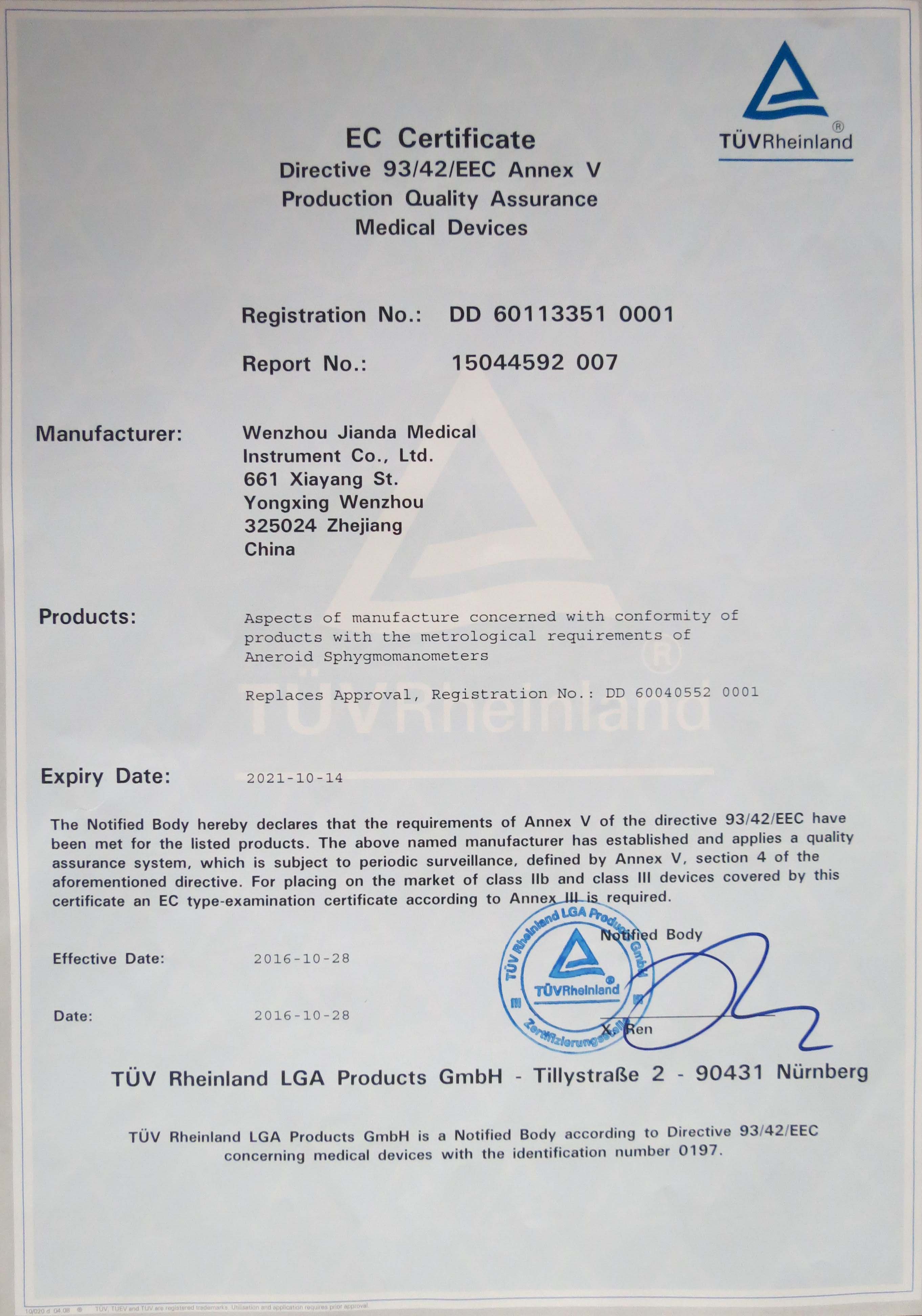
Wenzhou Jianda Medical Instrument Co.,Ltd. is a manufacturer and supplier of aneroid sphygmomanometer, stethoscope and other medical instruments such as digital blood pressure monitor,digital thermometer, medical device accessories. We produce more than 500,000 sets of sphygmomanometers and stethoscopes every year and our products have been exported to USA, EEC and many other countries.
Our Certificate

FAQ
Q: How does a thermometer work?
Q: What are the different types of thermometers?
Q: How accurate are thermometers?
Q: What is the normal body temperature?
Q: Can thermometers be used to measure the temperature of objects or liquids?
Q: Are there thermometers specifically designed for measuring the temperature of infants?
Q: Can I use a thermometer to measure the temperature of food?
Q: Can I use a thermometer to measure room temperature?
Q: Are there thermometers that can measure temperature without physical contact?
Q: How long does it take for a thermometer to provide a temperature reading?
Q: Can I use a thermometer to measure the temperature of a newborn baby?
Q: Can I use a thermometer to measure the temperature of a pet?
Q: Can I use a thermometer to measure the temperature of my oven?
Q: Can I use a thermometer to measure the temperature of my refrigerator or freezer?
Q: Are there thermometers that can measure both indoor and outdoor temperatures?
Q: Can I use a thermometer to measure the temperature of my body in different locations?
Q: Can I use a thermometer to measure the temperature of a hot beverage?
Q: Can I use a thermometer to measure the temperature of a baby's bathwater?
Q: Can I use a thermometer to measure the temperature of my car's engine?
Q: Can I use a thermometer to measure the temperature of my body during exercise?